Origen

Those Who Are Stupid Do Not Know They Are Stupid
There is a particular kind of ignorance that is difficult to recognize.
It is not simply the absence of knowledge.
It is the inability to recognize that we do not know.
We can be educated, experienced, successful, religious, political, intellectual, or highly informed—and still be completely unaware of the assumptions, fears, and identities that govern the way we see the world.
Perhaps this is why the title of this reflection is intentionally uncomfortable:
Those Who Are Stupid Do Not Know They Are Stupid.
But what if “stupid” does not mean unintelligent?
What if it describes something much more subtle?
The inability to observe ourselves.
The inability to question our own certainty.
The inability to recognize that the person who believes they understand everything may be the very person who has stopped looking.
What Does It Mean to Know That You Don’t Know?
There is an enormous difference between saying:
“I know.”
and saying:
“I know that I don’t know.”
The first can close the door.
The second opens it.
When we believe we already possess the truth, there is little reason to continue searching.
We defend.
We justify.
We explain.
We argue.
But when we recognize the limits of our understanding, something different becomes possible.
Curiosity appears.
Humility appears.
Listening becomes possible.
Self-observation begins.
The real question, then, is not how much information we possess.
It is:
How much of ourselves are we actually able to see?
Who Are You?
Imagine that someone asks you a very simple question:
Who are you?
What would you answer?
Perhaps you would give your name.
Your profession.
Your nationality.
Your religion.
Your political beliefs.
Your family role.
Your social status.
You might say:
“I am a lawyer.”
“I am a Christian.”
“I am a Republican.”
“I am a Democrat.”
“I am on the left.”
“I am on the right.”
These statements may describe aspects of your life.
But are they actually you?
You can observe your profession.
You can observe your political beliefs.
You can observe your religious beliefs.
You can observe your emotions.
You can observe your memories.
You can observe your thoughts.
So who is the one observing all of these things?
This question takes us beyond identity.
And into consciousness.
When Identity Becomes the Self
There is nothing wrong with having an identity.
We need names, roles, relationships, communities, and beliefs to function in the world.
The problem begins when we confuse these things with our entire being.
A role becomes an identity.
An identity becomes a belief.
A belief becomes a certainty.
And certainty becomes something we must defend.
At that point, questioning an idea can feel like questioning ourselves.
Someone disagrees with our political position.
We feel attacked.
Someone questions our religious beliefs.
We become defensive.
Someone challenges our worldview.
We stop listening.
Why?
Because the idea is no longer simply an idea.
It has become part of the identity we are protecting.
And once identity takes over, awareness becomes more difficult.
The Need to Belong
Human beings naturally seek belonging.
We want to feel connected.
We want to know that we are part of something larger than ourselves.
Families provide belonging.
Religions provide belonging.
Political movements provide belonging.
Communities provide belonging.
Cultures provide belonging.
There is nothing inherently wrong with this.
But belonging can become dangerous to awareness when we stop thinking for ourselves.
We begin to think:
“My group is right.”
“Their group is wrong.”
“My people understand.”
“They are the problem.”
And slowly, without realizing it, we stop observing.
We start repeating.
We stop questioning.
We start defending.
We become representatives of an identity rather than conscious observers of our own experience.
When Opposites Feed Each Other
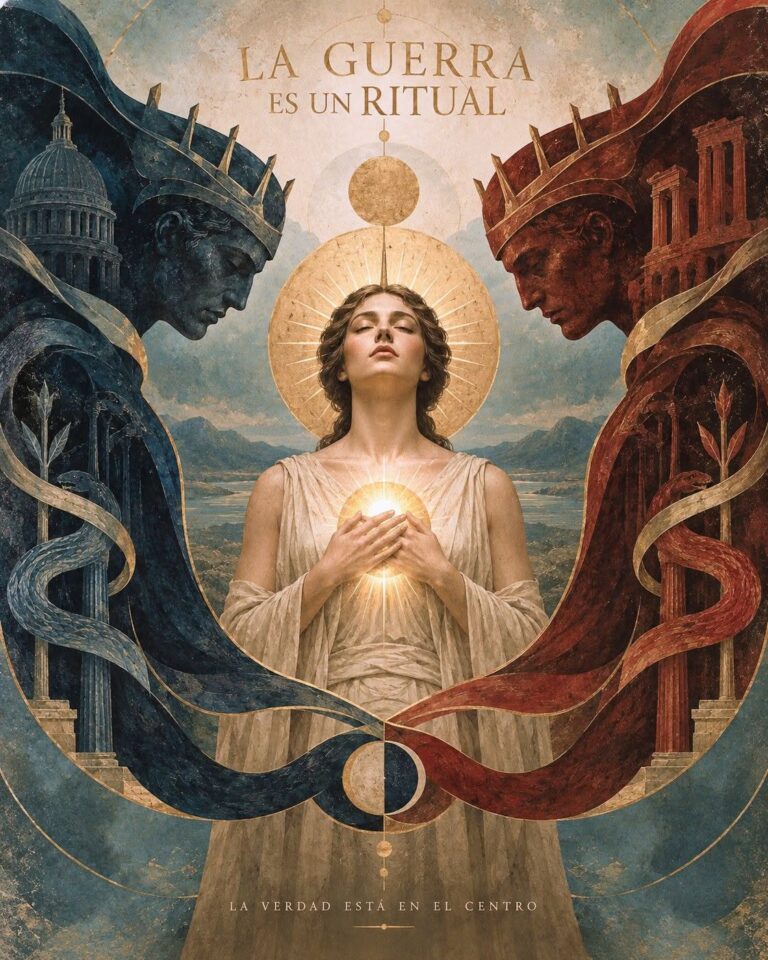
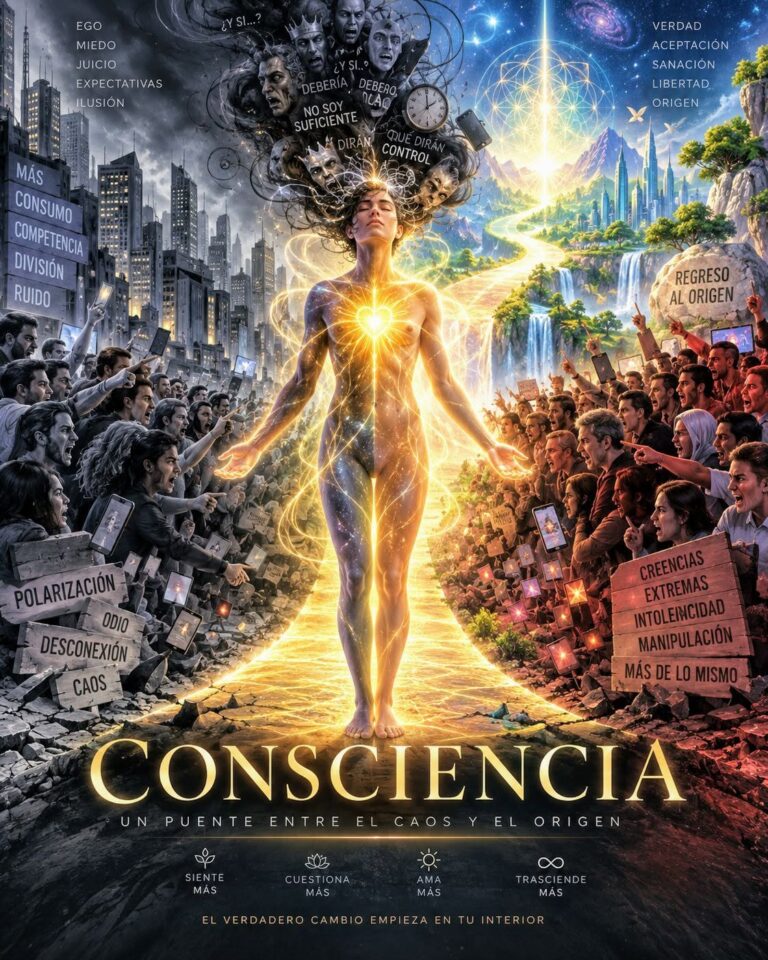
Polarization becomes especially powerful when opposing identities begin to define themselves through one another.
One side points toward the other.
The other responds.
Fear creates resistance.
Resistance creates more fear.
Accusation produces defensiveness.
Defensiveness produces another accusation.
The cycle continues.
The extremes can end up reinforcing each other.
And the more deeply someone identifies with one side, the more threatening the existence of the other side can appear.
At some point, the conversation is no longer about ideas.
It becomes about enemies.
And when another human being becomes an enemy, it becomes easier to stop seeing their humanity.
The War Before the Weapons
War does not begin only when weapons are fired.
The roots of conflict can appear much earlier.
They can appear when we stop listening.
When we stop questioning ourselves.
When disagreement becomes hatred.
When a person becomes a label.
When a group becomes an enemy.
When we believe that destroying the other person’s position is more important than understanding why they see the world differently.
Before there is violence between people, there can be separation within consciousness.
“Us” versus “them.”
This does not mean that wars are caused by individual psychology alone. Historical, political, economic, territorial, and social forces are complex and real.
But there is still an important human question:
What happens inside us when we can no longer recognize ourselves in the person standing across from us?
The Same Pattern Can Appear in Other Forms
The desire to escape ourselves does not appear only in political or ideological conflict.
It can also appear in everyday life.
Consider alcohol.
Not everyone who drinks has an alcohol problem, and people have different relationships with drinking.
But culturally, alcohol has often been associated with celebration, freedom, belonging, relaxation, courage, and social connection.
Birthdays.
Weddings.
Sports.
Parties.
Business meetings.
Celebrations.
We are repeatedly taught that certain moments become more enjoyable when consciousness is altered.
This raises a deeper question:
Why do we sometimes feel that we need to disconnect from ourselves in order to connect with others?
The question is bigger than alcohol.
It is about our relationship with consciousness.
How often do we seek distraction instead of presence?
How often do we look for something that will silence what we do not want to feel?
How often do we escape ourselves instead of becoming curious about ourselves?
Alcohol can therefore become a symbol of something much broader:
the human desire to temporarily step away from our own consciousness.
And perhaps the deeper question is not:
“Should people drink?”
It is:
“Why do we sometimes need to lose ourselves in order to feel free?”
The Mirror
One of the most uncomfortable aspects of self-awareness is discovering that our strongest reactions can become mirrors.
Someone says something we strongly disagree with.
We become angry.
Someone challenges our beliefs.
We feel threatened.
Someone criticizes us.
We feel wounded.
Someone succeeds where we wanted to succeed.
We experience jealousy.
Our first instinct is often to look outward.
“They made me angry.”
“They disrespected me.”
“They are ignorant.”
“They are the problem.”
But consciousness offers another question:
What is this reaction showing me about myself?
This does not mean accepting abuse.
It does not mean blaming ourselves for everything that happens.
It means becoming interested in what is happening inside us.
Instead of asking only:
“Why did they do that?”
we can also ask:
“Why did this affect me so deeply?”
That question creates space.
And within that space, observation becomes possible.
The Observer
You can observe a thought.
Therefore, you are capable of seeing the thought.
You can observe an emotion.
You can observe fear.
You can observe anger.
You can observe your beliefs.
You can observe your identity.
You can even observe the part of you that wants to defend itself.
So who is the observer?
This is not necessarily a question that can be solved through intellectual analysis.
It is a question that can be experienced.
Sit quietly.
A thought appears.
Observe it.
Another thought appears.
Observe that one too.
An emotion arises.
Observe it.
A memory appears.
Observe it.
You do not have to fight anything.
You do not have to follow anything.
Simply observe.
Thoughts change.
Emotions change.
Opinions change.
Identities change.
Circumstances change.
But there remains a capacity within you that can witness the movement.
That is the mystery of the observer.
The Center Is Not a Political Position
When we speak about finding the center, we are not talking about political centrism.
The center is not another ideology.
It is the place within consciousness from which we can observe without immediately reacting.
From the center, we can disagree without creating an enemy.
We can listen without surrendering our discernment.
We can question without feeling threatened.
We can change our minds without experiencing that change as a loss of identity.
From the center, we can say:
“Maybe I am wrong.”
And perhaps even more importantly:
“Maybe I don’t know.”
There is extraordinary freedom in those words.
Because when we no longer need to pretend that we know everything, consciousness becomes available for discovery.
The Real Problem Is Not Being Wrong
Being wrong is not the greatest problem.
We are all wrong about something.
We all carry incomplete information.
We all have blind spots.
We all inherit beliefs from our families, cultures, societies, and experiences.
The deeper problem is being unable to see that we have blind spots.
That is where ignorance becomes invisible.
And invisible ignorance is difficult to transform because we do not recognize that there is anything to transform.
This is why self-knowledge requires more than collecting information.
It requires observation.
It requires humility.
It requires the courage to look at ourselves without immediately defending what we find.
The Freedom to Question Yourself
Perhaps one of the highest forms of freedom is the freedom to question yourself.
To question your beliefs.
To question your reactions.
To question your identity.
To question the stories you have been telling yourself.
To question what you inherited.
To question what you were taught.
Not because everything you believe is false.
But because anything that cannot be questioned can eventually become a prison.
The goal is not to have no beliefs.
The goal is to avoid becoming imprisoned by them.
You can have convictions and still remain open.
You can belong to a community and still think independently.
You can disagree and still remain connected to another human being.
You can know something and still remain humble about what you do not know.
That is awareness.
Who Is Stupid?
Perhaps the word “stupid” in this reflection should not be used as an insult.
Perhaps it should be used as a mirror.
Not:
“Look at how stupid they are.”
But:
“Where am I unable to see?”
Where am I defending instead of observing?
Where am I reacting instead of listening?
Where have I confused a belief with reality?
Where have I confused an identity with consciousness?
Where do I need to be right?
Where do I need someone else to be wrong?
Where am I afraid to say:
“I don’t know.”
These questions turn the mirror toward ourselves.
And that is where transformation begins.
Returning to the Origin
The journey back to the origin is not necessarily about becoming someone new.
Perhaps it is about removing what we have mistaken for ourselves.
The labels.
The roles.
The inherited beliefs.
The fears.
The divisions.
The stories.
The constant need to defend an image of who we think we are.
Perhaps beneath all of this there is something much simpler.
Something that does not need a label.
Something that does not need to win.
Something that does not need to prove itself.
Something that can simply observe.
Be present.
Be still.
Return.
Maybe awakening begins with a very simple recognition:
“I do not know.”
Not as defeat.
But as openness.
Not as weakness.
But as humility.
Not as ignorance.
But as the beginning of seeing.
So ask yourself:
Who am I beyond my labels?
What beliefs have I never questioned?
Which identities am I protecting?
What do my strongest reactions reveal about me?
Can I listen to someone who disagrees with me without turning them into an enemy?
Can I observe my own mind without immediately believing everything it tells me?
And finally:
Who is the one observing all of this?
Perhaps the greatest discovery is not finding another identity.
It is discovering what remains when identity becomes quiet.
Before the label.
Before the role.
Before the ideology.
Before the division.
Before the need to be right.
There is the observer.
There is awareness.
There is silence.
And perhaps, in that silence, we return to the place from which the journey began.
The silence where God resides.
🌿 The journey continues.